.png)
Design Build vs Architect: Which Is Right for Your Oklahoma Home?
Building a custom home in Oklahoma is an exciting journey, but the very first choice you make can define your entire experience. Before you dream of countertops or flooring, you must decide between design build vs architect. This critical decision impacts your budget, timeline, and final product, shaping everything from the first sketch to the day you get your keys.
Making the wrong choice can lead to budget overruns, frustrating delays, and a home that doesn't quite match your vision. This guide, backed by ACET Custom Homes' 15+ years of local building experience, will give you the actionable insights and real-world examples you need to confidently choose the right path for your Oklahoma dream home.
Choosing Your Path: Design-Build vs. Architect
Before a single shovel hits the dirt on your dream home in Edmond or Deer Creek, you need to pick your project delivery method. This isn’t just a minor detail; it’s a choice between two fundamentally different ways of handling project management, accountability, and communication.
At its core, the difference is simple:
- Design-Build: You sign one contract with one team responsible for everything from architectural design to construction. It's a single, integrated process.
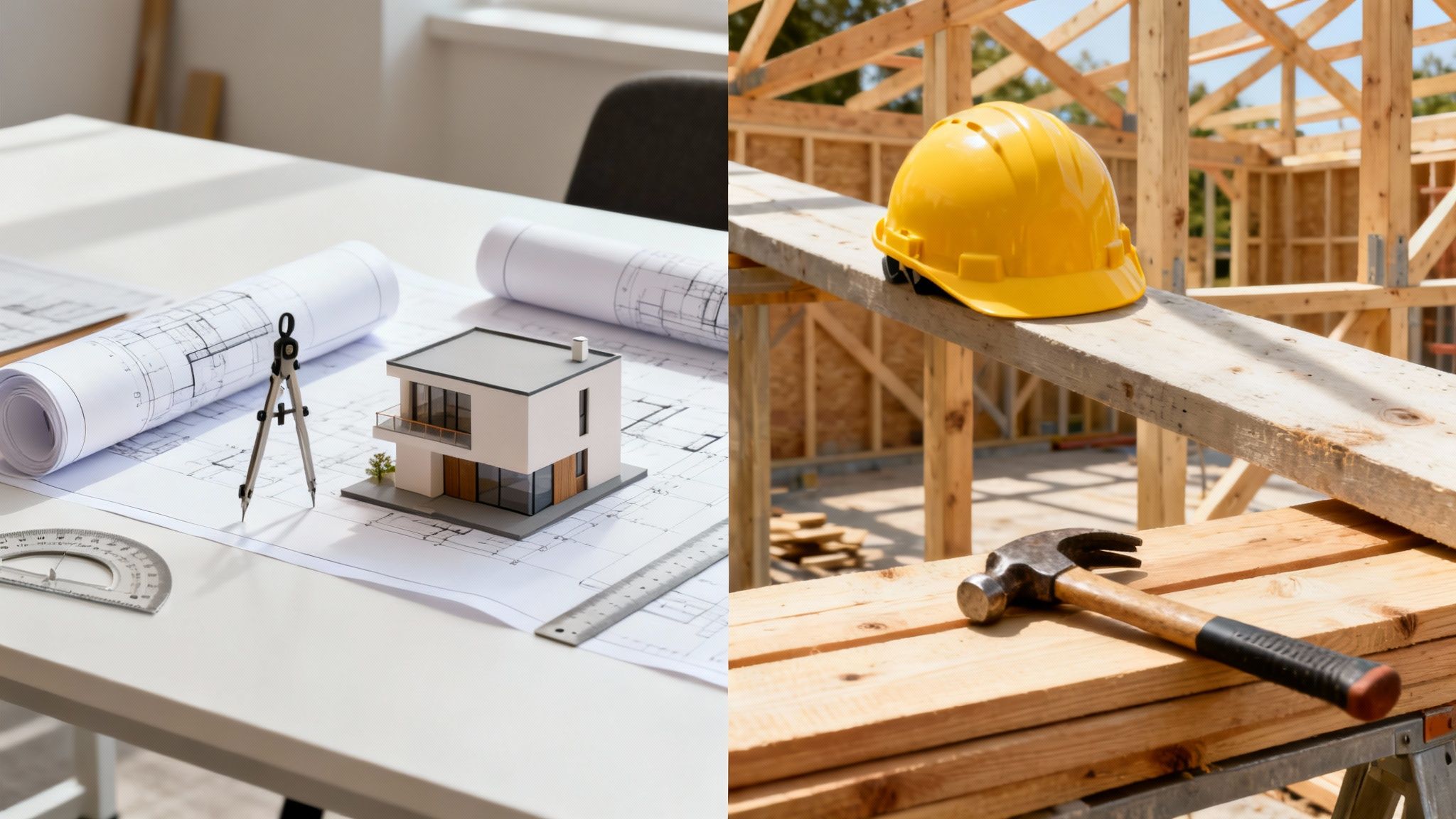
- Traditional Architect-Led (Design-Bid-Build): You sign separate contracts, first with an architect for the design, then with a builder for the construction. It's a linear, two-step process.
This guide provides a transparent, side-by-side comparison to help you choose the best path. We’ll dig into process flow, cost control, and risk management, giving you the clarity needed to make an informed decision for your Oklahoma build.
Quick Comparison: Design-Build vs. Architect-Led
FactorDesign-Build (One Team)Architect-Led (Two Teams)ContractsOne unified contract for design and construction.Two or more separate contracts (architect, builder).AccountabilitySingle point of responsibility. The firm owns the entire outcome.Divided responsibility. Can lead to finger-pointing between designer and builder.BudgetingReal-time cost feedback during the design phase. Prevents surprises.Cost is unknown until after design is complete and bids are collected.TimelineFaster due to overlapping design and construction phases.Slower due to a linear, step-by-step process.
Understanding these distinctions is the first step. The model you choose directly influences how real-world challenges—like engineering a foundation for Oklahoma's expansive clay soil or managing weather delays—are handled.
Defining The Two Custom Home Building Models
When you're deciding between the design-build vs. architect route, you need to know exactly what you're getting into. These aren't just different names for the same thing—they represent two completely different project structures.
The biggest difference boils down to contracts and accountability. One model brings everyone under one roof, streamlining responsibility. The other separates the process into distinct, linear phases, placing more management burden on you, the homeowner.
The Design-Build Model: An Integrated Approach
The design-build model is an all-in-one approach where a single company is responsible for your entire project. One contract, one team. This team handles everything from the initial architectural sketches and interior design to the final construction and walkthrough. At ACET Custom Homes, this unified method is our specialty.
Designers, estimators, and builders collaborate from day one. This constant communication means design decisions are immediately checked against real-world construction costs and feasibility—a huge advantage when building in Oklahoma.
Actionable Insight: With design-build, ask for a detailed project timeline that shows how design, permitting, and site work will overlap to save time.
Builder Insight: The real magic is accountability. When design and construction are one team, there’s no finger-pointing. If a problem with the HVAC design arises during framing, a single entity is on the hook to solve it, shielding you from playing mediator.
The Traditional Architect-Led Model: A Linear Process
The traditional architect-led model, also known as Design-Bid-Build, is a linear, fragmented process. You start by hiring an architect to create a complete set of construction plans, often without any input from a builder on cost or material availability in the Oklahoma City market.
Once you have finished blueprints, you take them out to bid with several general contractors. You then select a builder, sign a separate contract, and only then does construction begin. This step-by-step nature can easily create a communication gap between the creative vision (architect) and the practical execution (builder).
This separation is a primary reason the model is losing ground. Data from the Design-Build Institute of America (DBIA) shows that design-build is projected to account for nearly half of all U.S. construction spending by 2026, as owners increasingly favor integrated, collaborative approaches.
Comparing The Project Journey Step by Step
To really understand the difference between design-build vs. architect-led, you need to walk through how each process unfolds. Think of one as a collaborative sprint with the whole team running together, and the other as a relay race where the baton is passed from one expert to the next.
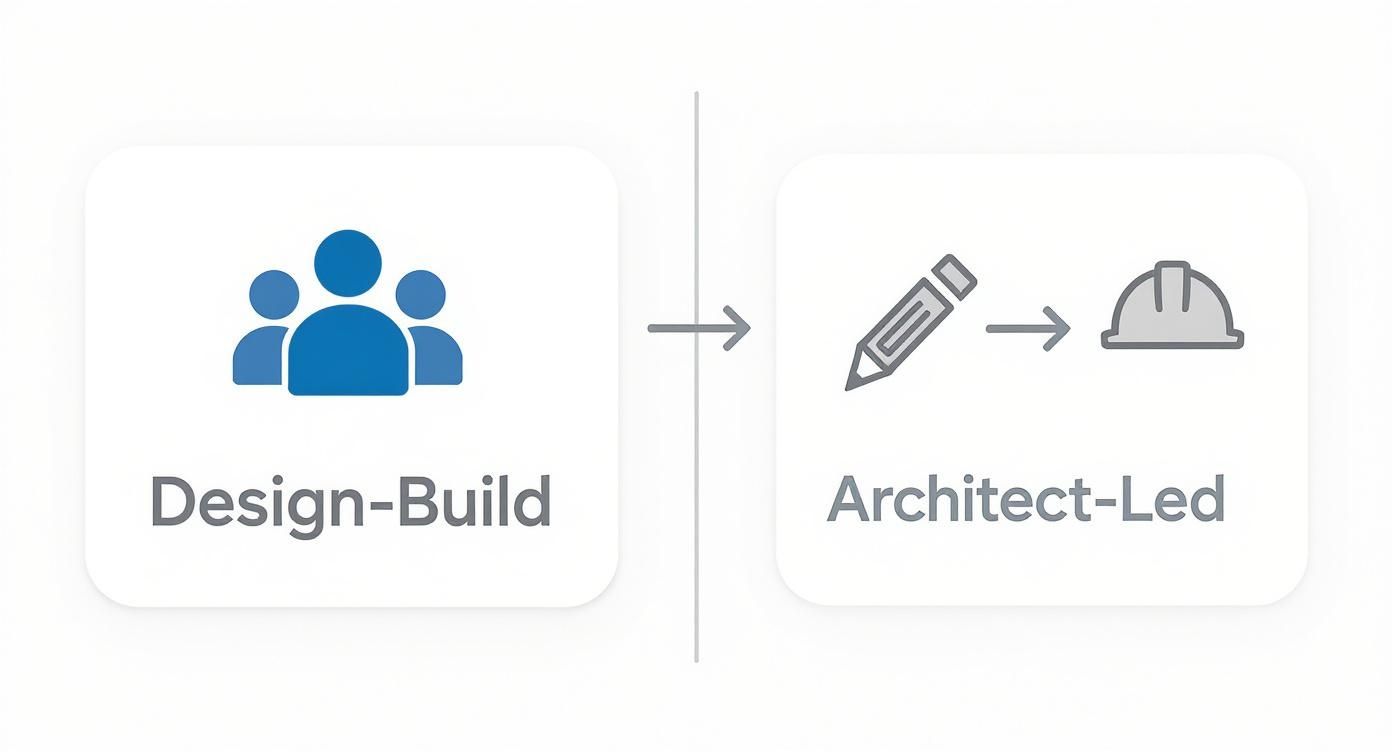
The biggest takeaway is the flow of information. With design-build, conversations about cost, practicality, and design happen constantly. The traditional model can create information gaps between each handoff.
The Design-Build Project Journey (Integrated Workflow)
With the design-build model, everything is integrated from your very first meeting. Design, cost analysis, and construction planning happen concurrently, creating a feedback loop that prevents surprises.
A Real Oklahoma Example:You want to build a home in Edmond with a large covered patio featuring an outdoor kitchen. Our design team sketches a beautiful layout. At the same table, our construction estimator immediately prices the required footings, the specific masonry for Oklahoma's climate, and the plumbing and electrical runs. This real-time collaboration solves problems before they even start.
Step-by-Step Breakdown:
- Integrated Design & Budgeting: Your vision, budget, and lot constraints are discussed with the entire team—designer, project manager, and estimator—from day one.
- Value Engineering: As the design takes shape, it's constantly checked against the budget. If a feature is too expensive, the team finds a smart alternative on the spot, without compromising the look and feel.
- Seamless Transition to Construction: Once the design and budget are locked in, there’s no bidding process. The same team that designed your home moves into the building phase. We often order long-lead-time materials during the final design stage to prevent delays.
ACET Builder Insight: We address Oklahoma’s expansive clay soil during initial design. Our structural engineer, designer, and construction manager collaborate to engineer the right post-tension foundation with immediate cost feedback. This prevents a six-figure surprise later—a classic pitfall of the traditional model where the foundation isn't fully engineered until after the design is "complete."
The Architect-Led Project Journey (Linear Workflow)
The traditional architect-led journey is a sequence of separate stages. Each must be fully completed before the next can start, which can lead to friction, delays, and expensive do-overs.
A Real Oklahoma Scenario:An architect designs a stunning cantilevered roofline for your home in Deer Creek. The design is breathtaking, and the plans are finished. You take those plans to three builders for bids. Every quote comes back $100,000 over budget. The builders explain the engineering needed to make that roof withstand Oklahoma's high winds is far more complex and costly than anticipated.
Your Red Flag: If an architect can't provide recent, comparable cost-per-square-foot data for their designs, you risk falling in love with a plan you can't afford.
Step-by-Step Breakdown:
- Architect Selection & Design: You hire an architect who creates a full set of construction documents based on your vision.
- The Bidding Process: You take the finished plans and solicit bids from multiple general contractors. This can take weeks or months.
- Contractor Selection: You review bids and vet contractors, often choosing the lowest price, which carries its own risks related to quality.
- Construction Begins: The builder starts construction, working from plans they had no part in creating. Any design flaw discovered on-site becomes a change order, causing delays and driving up your cost.
Key Decision Factors: Cost, Timeline & Accountability
When you're trying to decide between design-build vs. an architect, it boils down to three things: cost, timeline, and accountability. The way each model handles these pillars reveals everything you need to know.
Cost Control: A Tale of Two Budgets
In the design-build world, cost is part of the conversation from day one. Because our designers and builders are a single team, we provide real-time pricing feedback as your home's plans take shape. We call this value engineering.
Say you love a specific stone for the fireplace. Our team can price it on the spot and, if needed, show you a nearly identical alternative that might save thousands without compromising the aesthetic. This prevents the single biggest frustration in home building: sticker shock.
Cost Factor to Watch: In the architect-led model, watch for "allowances." Vague allowances for items like cabinets or flooring can hide major budget risks. Design-build specifies exact products and costs early on.
ACET Builder Insight: With design-build, your budget drives the design. In the traditional model, the design dictates the budget, which often forces painful cuts after you've already fallen in love with a plan you can't afford.
Project Timelines: Overlapping vs. Linear
The design-build process is designed for efficiency, allowing phases to overlap and shaving significant time off the project.
For example, while our design team is helping you finalize interior selections with our 3D design service, our construction crew can already be clearing the lot, pouring the foundation, and starting to frame. This parallel workflow can cut months off the schedule, as detailed in our guide on how to build a custom home in Oklahoma.
The traditional model is inherently slower because it is linear. You must finish 100% of the design before you can even start looking for a builder.
Accountability: One Team vs. Two
This might be the biggest difference. With design-build, one company is responsible for the entire project. If there’s an issue, there’s no finger-pointing—just one team with one goal: solve the problem.
This single point of accountability is your best protection. We’ve seen traditional projects get bogged down when a design flaw is blamed on the architect, but the resulting construction mistake is blamed on the builder. The homeowner gets stuck in the middle.
With design-build, the risk for design errors and omissions is shifted from the owner to the design-build team, providing a single source of responsibility. This is a key finding in construction industry risk management studies by organizations like the National Institute of Building Sciences.
FAQ: Answering Your Top Questions
Is design-build cheaper than hiring an architect?
It's not always cheaper, but it is almost always more cost-effective. With design-build, design and construction services are bundled, often leading to lower overhead. The real savings come from cost control; by designing to a budget from day one, you avoid expensive redesigns and budget overruns common in the architect-led model.
Which model offers more creative freedom?
An independent architect may pitch more avant-garde concepts, but these ideas can be disconnected from real-world construction costs. A design-build firm offers practical creative freedom. Our in-house designers collaborate with our construction experts to ensure every creative idea is grounded in buildability and your budget, so your dream home actually gets built as envisioned.
What are the main downsides of the design-build model?
The biggest potential drawback is that you place all your trust in a single firm. This makes choosing the right design-builder absolutely critical. A reputable firm like ACET Custom Homes mitigates this with radical transparency, detailed contracts, and an open-book approach to budgeting so you always know where your project stands.
Can I bring my own architectural plans to a design-build firm?
Yes. If you already have plans but want the streamlined execution of design-build, a firm can take over for the construction phase. At ACET, we perform a thorough plan review first, checking for buildability in Oklahoma, flagging budget risks, and suggesting value engineering to save you money without compromising the vision.
Ready to design your custom home? Schedule a free consultation with ACET Custom Homes today.
Book Your Project Consultation