.png)
What to Know Before Buying Land to Build a Custom Home in Oklahoma
Quick answer: Before buying land for a custom home in Oklahoma, confirm more than the acreage and purchase price. The property should be evaluated for legal and construction access, utilities, wastewater, drainage, easements, setbacks, topography, site-development costs, financing implications, and whether the home you want actually fits the site.
A beautiful property can still become an expensive building site. Early construction-oriented review can help identify those issues before closing, when you still have options.
1. Do not choose land based on appearance alone
Views, trees, privacy, and acreage matter, but they do not tell you what it will cost to build. A homesite should also work for the house footprint, driveway, drainage, utilities, wastewater system, construction access, and future outdoor spaces.
If possible, involve the builder while evaluating the property rather than waiting until after the purchase.
2. Confirm legal access and practical construction access
Verify that the property has appropriate legal access. Then consider whether concrete trucks, framing deliveries, cranes, excavation equipment, and other construction traffic can physically reach the proposed homesite.
Long driveways, narrow entrances, drainage crossings, culverts, gates, steep grades, or private-road conditions can add meaningful site-development scope.
3. Verify utilities before assuming they are available
Seeing power lines or nearby houses does not guarantee that service to your proposed homesite will be simple or inexpensive. Contact the applicable providers and confirm what is available.
- Electric: Determine the serving utility, nearest service point, and possible extension requirements.
- Water: Confirm municipal or rural-water availability, tap requirements, meter requirements, and whether capacity is available.
- Wastewater: Determine whether public sewer is available or an onsite wastewater system may be needed.
- Gas or propane: Confirm available options based on the property and home design.
- Internet: Rural broadband availability can vary significantly from one parcel to the next.
4. Understand the wastewater plan
If public sewer is unavailable, do not assume that any septic system can simply be installed anywhere on the property. The appropriate solution depends on site conditions, the proposed home, and applicable requirements.
Wastewater planning can also affect where the home, driveway, utilities, pool, shop, or other improvements can be placed.
5. Review drainage and topography
Walk the property with water movement in mind. Look for low areas, channels, steep slopes, ponding, creek crossings, erosion, and evidence of concentrated runoff.
Home placement and grading can change how water moves across a site. Depending on the property, drainage planning may involve grading, swales, culverts, retaining solutions, erosion control, or professional engineering.
For a deeper checklist, read ACET's Oklahoma site-preparation guide.
6. Review surveys, easements, setbacks, and restrictions
A current survey and title information can help identify property boundaries and recorded easements. Local requirements, covenants, or architectural restrictions may also influence where and what you can build.
The most attractive part of the parcel is not automatically the best or legally available homesite.
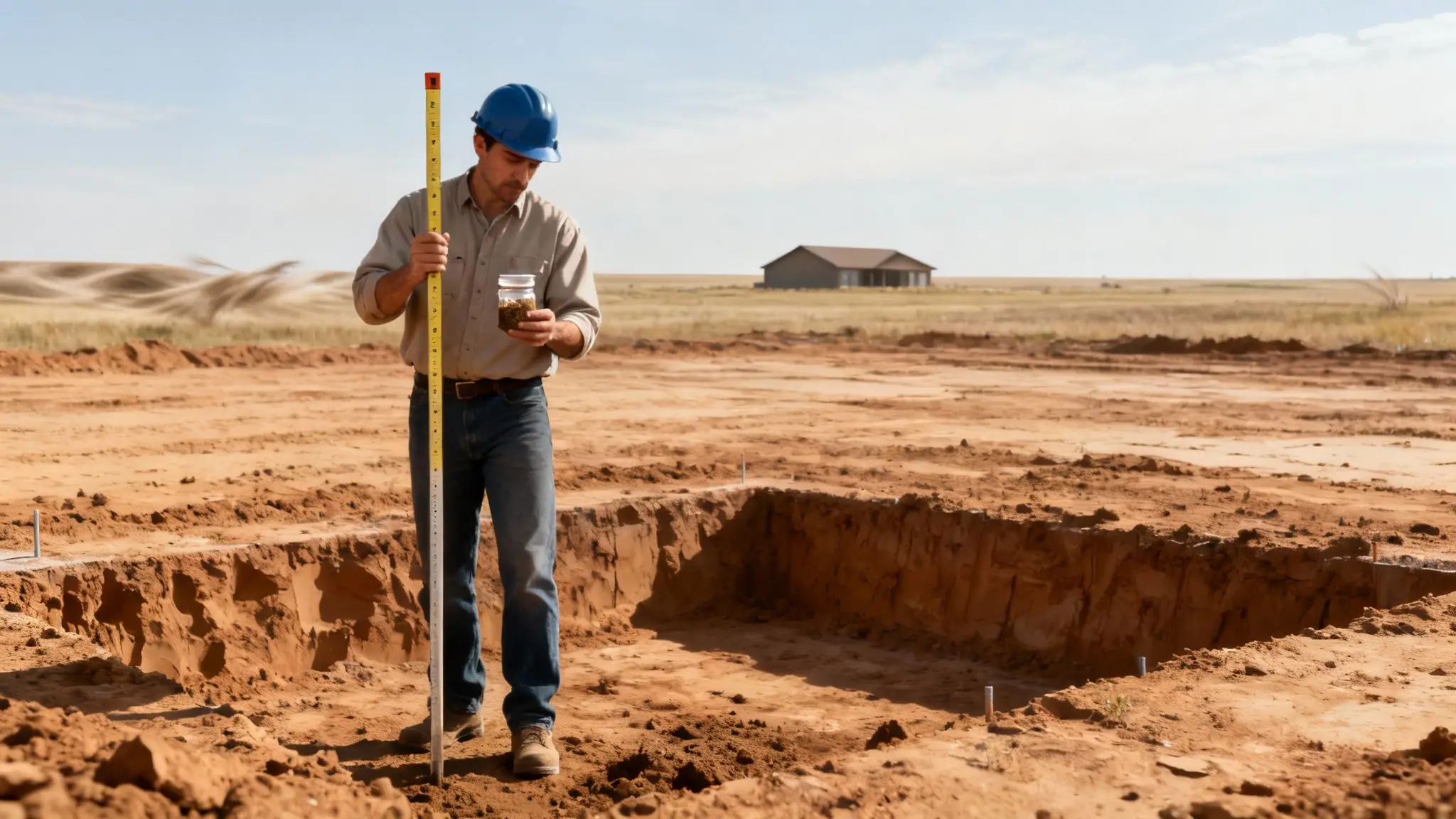
7. Treat foundation and soil decisions as site-specific
Oklahoma properties vary. Do not purchase land based on an assumption that every site needs the same soil test or foundation system.
The appropriate site information and foundation design should be determined for the actual project by the relevant qualified professionals. The important step before purchase is recognizing that unusual soil, fill, slope, drainage, or site conditions can affect engineering and construction cost.
8. Estimate the site-development scope before finalizing the home budget
The cost of the house is only part of a build-on-your-land project. Depending on the property, the total project may also include clearing, grading, drainage, driveway construction, utility extensions, wastewater systems, surveys, testing, engineering, and other infrastructure.
That is why ACET does not use one universal cost-per-square-foot number as an official project price. Two identical homes on different properties can have substantially different total investments.
See ACET's custom-home cost guide for broader budgeting guidance.
9. Make sure the desired floor plan fits the property
Do not buy a lot for a specific plan without checking the relationship between the two. The home footprint, garage orientation, driveway approach, setbacks, views, outdoor living, drainage, utilities, and wastewater requirements all influence site fit.
ACET clients may bring an existing plan, customize an ACET floor plan, or combine ideas into a personalized design. The final design still needs to work with the property, engineering, constructability, and budget.
10. Consider construction financing before closing on land
ACET Custom Homes is not a lender and does not provide financing. If construction financing will be used, speak with qualified lenders early enough to understand how the land purchase, land equity, appraisal, borrower qualifications, builder approval, and future construction loan may work together.
Loan structures and requirements vary. Do not assume the lender will value the land, required equity, or construction budget exactly as expected.
For an overview, see ACET's Oklahoma construction-loan guide.
11. Ask for builder input before the purchase when possible
A builder can look at the property through a construction lens: where the home may sit, how equipment will enter, where utilities may come from, how long the driveway could be, and which site questions should be investigated further.
That review is not a substitute for surveys, engineering, title work, governmental determinations, or other professional due diligence. It can, however, help you ask better questions before making a major commitment.
12. Build a land due-diligence folder
Keep the listing information, survey, title documents, utility correspondence, restrictions, maps, financing information, and any professional reports in one place. Good documentation makes it easier for the builder, lender, designer, engineer, and other project professionals to work from the same information.
Questions to ask before buying land
- Where can the home realistically sit?
- Is there legal and practical access?
- Who provides electricity and water?
- Is public sewer available?
- What wastewater solution may be required?
- Are there easements or setbacks affecting the homesite?
- How will water drain across the property?
- What clearing or grading may be needed?
- How long will the driveway be?
- Will utilities need significant extensions?
- Does the desired floor plan fit?
- Could site work materially change the total project budget?
- What due diligence should be completed before closing?
Frequently asked questions
Do I need to own land before contacting ACET?
No. ACET can be a resource while clients evaluate potential properties. ACET does not currently sell land or lots.
Can ACET tell me whether a property is buildable?
ACET can provide construction-oriented input, but formal determinations may require surveys, engineers, utilities, title professionals, governmental authorities, wastewater professionals, or other qualified parties depending on the issue.
Is acreage always more expensive to develop?
Not automatically. Site-development cost depends on the actual property. Acreage can involve longer driveways and utility runs, but every parcel should be evaluated individually.
Should I choose the floor plan before buying land?
You can develop a floor-plan direction, but the property and home should be evaluated together before the design is treated as final.
How long does a build-on-your-land project take?
ACET's broader planning-to-completion journey can take roughly 12 to 18 months, while actual construction once fully ready to build is commonly around 8 to 10 months. These are planning ranges, not guarantees.
Buy the property with the complete project in mind
The right land is not simply the parcel you like most. It is land that can support the home, infrastructure, budget, and lifestyle you are planning.
Considering land for a custom home in Oklahoma? Contact ACET Custom Homes before closing to discuss the property, floor-plan direction, project range, and construction questions worth investigating.
Book Your Project Consultation